
Artificial intelligence does not always announce its presence. It can appear in a customer-service e-mail, decide which advertisement reaches us, shape the videos recommended on our social feeds, or form part of systems used to identify people. What was once largely associated with research labs and technology companies is now becoming part of everyday life. We see some of it. Much of it works quietly in the background.
And as AI moves deeper into the systems we rely on, the questions around it are becoming harder to keep within the boundaries of technology.
How safe is the internet when AI is increasingly involved in what we see, share, and consume?
What happens when governments begin using AI to administer public services, assess risks, or make decisions that affect people’s lives?
How transparent are the rules governing these systems, and who gets to scrutinize them?
When a powerful AI system causes harm, who is responsible: the developer, the company deploying it, the institution using it, or the machine itself?
And perhaps most importantly, are ethics and fundamental rights being built into AI from the beginning, or are they being considered only after something goes wrong?
European Union’s history with AI
As the AI wave increasingly takes center stage on a global podium, Europe has recognized this shift. On August 2, 2026, the European Commission, in accordance with national authorities, issued a declaration enforcing the EU AI Act- the first regulation on artificial intelligence.
The objective is to deploy a framework for how AI will be used across different sectors.
The framework is designed to ensure safety, transparency, and protection of fundamental rights in a democracy. The EU AI Act classifies AI systems based on the risks their deployment could pose to people’s rights, safety, and society.
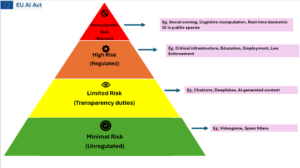
As regulations around AI have finally taken the shape of legislation, it is important to understand that the EU AI Act does not mark AI’s arrival in Europe. Its roots trace back much further.
For decades, the technology has been developing, progressing from initial symbolic systems and expert programs through to machine learning and the deep-learning revolution of the 2010s; what had originally been merely a field of research has since become part of the products, services and systems that affect daily life.
Europe’s reply came later and changed as the technology developed.
In 2018, the European Commission started developing a coordinated European strategy for AI, linking Member States, researchers, the industrial sector, and civil society. A year later, the High-Level Expert Group issued the Ethics Guidelines for Trustworthy AI, putting human oversight, transparency, accountability, privacy and fundamental rights on a par with technical robustness.
By 2020, the focus had shifted from principles to regulation, and the Commission’s White Paper on AI had suggested a European approach based on excellence and trust.
In 2021, the approach was given legislative form.
The European Commission proposed the AI Act, introducing a risk-based framework that distinguishes between different uses of AI and places stronger obligations on systems that pose greater risks to safety and fundamental rights. The process of getting from rules on paper to rules in practice has now started. Certain provisions came into force in 2025. On 2 August 2026, the AI Act reached another important milestone when its applicable provisions entered a major enforcement phase and new transparency requirements took effect. Other obligations, including those relating to high-risk systems, will be introduced later. The situation in Europe has shifted from questioning how AI should be governed to testing whether it can actually govern its effects. An AI Act may lay down obligations but cannot on its own resolve every question that arises regarding AI. It cannot, by itself, settle every question that AI raises.
Suppose an AI system is used to assist in administering public services. It might work more quickly and help organizations to make decisions more efficiently. Yet if such a decision affects a person’s access to a service, benefit, or opportunity, efficiency must not be the only criterion for success.
Can this individual grasp the manner in which the decision was arrived at?
Can they challenge it?
Then who is responsible for checking the system for any bias?
Then who is to be held responsible in the event of a failure?
The difficulties involved in these questions increase as AI appears in elections, public debate, the workplace, and the information we take in every day.
It is important to be transparent, because if we know that an image has been produced by AI or that we are dealing with a machine, we gain information and a sense of control. However, transparency by itself does not inform us about who designed the system, whose interests influenced it, what assumptions it contains, or who has the power to change it.
That is the reason why governance of AI involves more than just technology.
It is about power.
So, what comes next?
Europe has decided to regulate artificial intelligence by using a system that focuses on risk, accountability, and fundamental rights. However, regulation is not the end of the process; it is instead an ongoing discussion concerning what society regards as acceptable, what it sees as dangerous, and who is allowed to make those decisions.
Europe isn’t the only one having that conversation.
All governments, technology companies, international organizations, researchers, and members of civil society are currently discussing the question of how AI should be governed, while at the same time AI keeps on developing, usually at a speed that exceeds the ability of institutions to react.
Perhaps, then, the question is no longer simply:
How do we control AI?
Perhaps we should ask:
Who is to decide what AI should become?
How much power ought we to give to machines?
Can AI strengthen democracy without weakening human agency?
And can technological progress remain compatible with digital freedom?
These questions cannot be answered by legislation alone. They require public debate.
That is the conversation Europe needs to have next.
In light of the importance of this conversation, European Pirates, in association with the Pirates Parties International, has undertaken to facilitate it. The stage is set for the conversation that matters at Think Twice 2026 in Brussels on 16–17 October, where AI and governance will be examined from both sides of the equation: AI for Governance and Governance of AI.
Not as a debate about technology for technology’s sake, but as a question about the society we are building around it.
Because AI is already here.
The question is what we do with it.